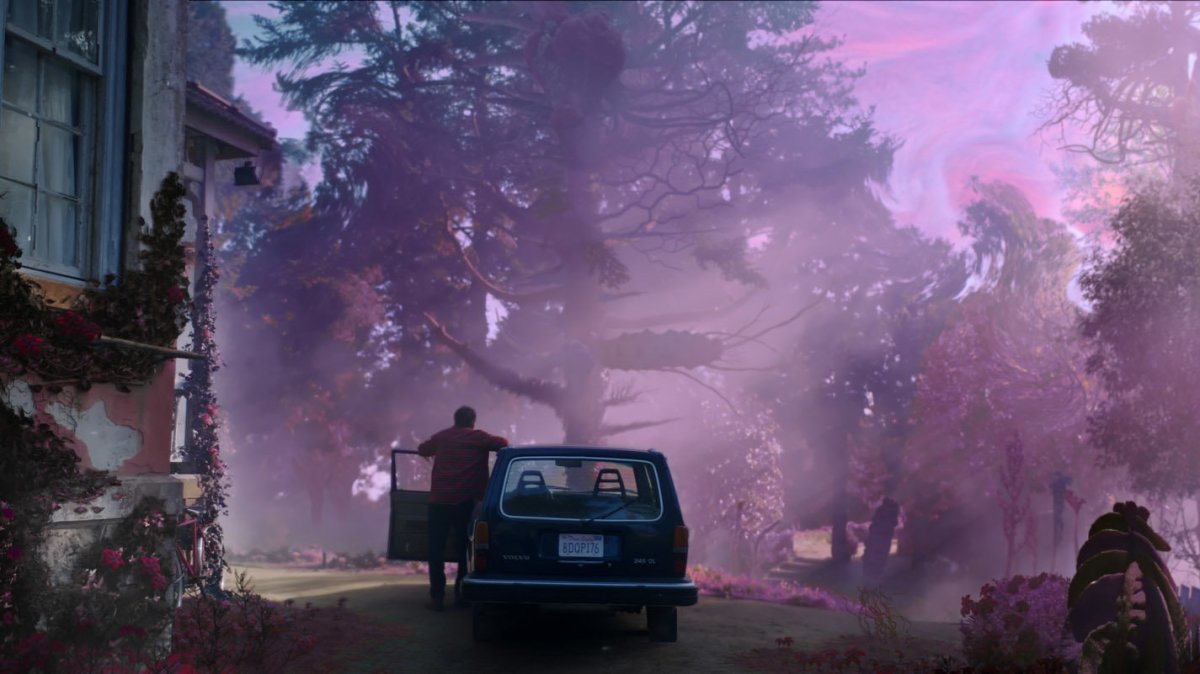
It’s understandable that Hollywood, as enamored with H.P. Lovecraft’s writings as it is incapable of imitating them, keeps plowing the fertile grounds of “The Colour out of Space,” one of his most upsetting, easily filmable, and least racist works. A majority of Lovecraft stories would require non-Euclidian sets; all you’d theoretically need for “Colour” is a versatile makeup department and some actors willing to commit. Sometimes you don’t really have either (1987’s The Curse) and sometimes you have both (2018’s excellent Annihilation). The latest take, a modernized adaptation from Richard Stanley, certainly has both, but much like the Color itself, it might start to disappear as soon as you look away.
In the original narrative, first published in 1927, a meteorite crashes into a Massachusetts farm, dissipates into the soil, and over the course of several years, ruins the property and the family that owns it in decreasingly subtle and increasingly harrowing ways. It’s my favorite Lovecraft story, a pick I actually share with Lovecraft. “The Colour Out of Space” is a slow burn with an agonizing payoff, and despite its painfully human dramatis personae, few works in any medium articulate the idea of cosmic horror as well as the Color; even Cthulhu himself is arguably sentient, while the Color just is, and the Gardner family has the tremendous bad luck of being in the same zip code. This adaptation hews close to the original text, but like nearly all Lovecraft adaptations, it seems afraid to engage with its most compelling parts.
We’ll get to that in a minute, though.
First things first: there’s a lot to like here. Credit goes to Stanley, who could have been cowed by his Dr. Moreau firing and subsequent absence from the triple-A level, but instead showed up to make something loud. Fittingly, the color palette is exquisite, and that’s more important than you might expect; as difficult as it must be to film something described in the source as imperceivable by sight, Kate Byron’s production and Sergio Costa’s art design impeccably build a world and push something foreign and wrong through the cracks. In almost any horror film, and especially with one as overwhelmingly visual as Color Out of Space, that’s half the battle. It’s aided by an excellent score from Colin Stetson, fast proving himself a master of compositions that feel like they should be less distressing than they are (seriously, have you seen the Uzumaki trailer? How does he do that?), and the cast, if not flawless, puts in solid work.
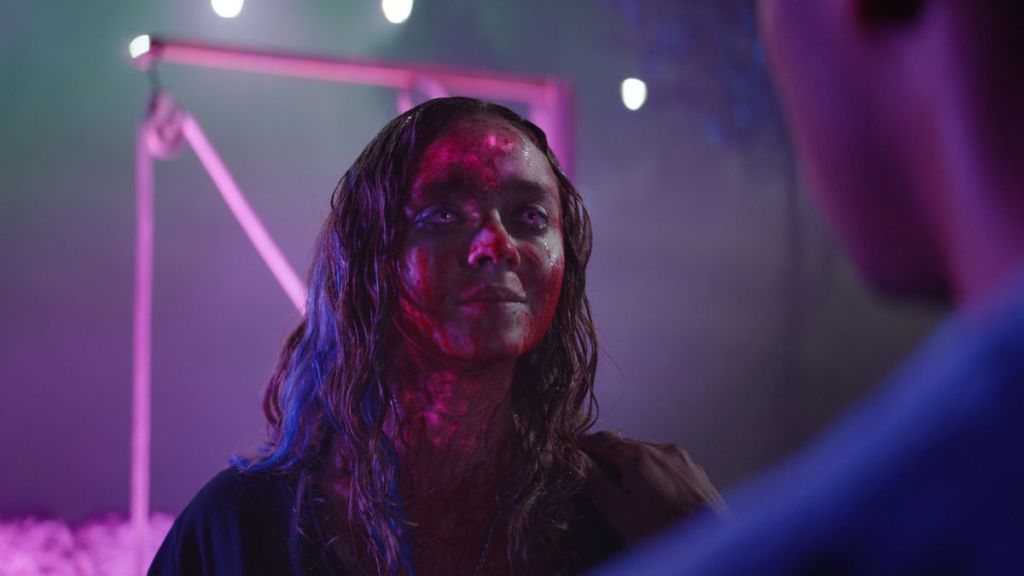
It’s the script where things start to head south. Color is weighed down by sputtering expositional dialogue that openly refuses to trust the audience to read the context clues (e.g., and spoilers: the father, Nathan, blood on his face from putting down his diseased alpacas, tells his kids to leave the room with their infected mother. “What are you going to do?” they ask. “Handle it,” he responds. We’re given a few upsetting beats before the kids take the air out of the scene and ask “like you handled the alpacas?”). Perhaps this constant snapping to make sure we’re still paying attention is helpful, as the script is full of interesting but half-baked ideas, threads and themes that it doesn’t seem to know what to do with. Lavinia’s Wiccan predilections, Theresa’s mastectomy, Nathan’s tendency under duress to mirror his father, and Jack’s attunement with the Color are a few of many ideas that feel like they should have been used either more or less. This is, to some degree, the fault of the new time frame; where the original happens over the span of decades, Color takes place within a week. It works, but barely. Without the benefit of time to soften the edges, the plot races and the characters can feel abrupt; Nicolas Cage, in trademark Nicolas Cage fashion, leaves it all on the field, but never quite feels like he’s playing the same person from scene to scene.
This frantic nature leads me to my biggest gripe, a gripe I’d first like to acknowledge is wholly personal and based on my love for the original, rather than any kind of objective criticism: overall, out of necessity of time, Color leans towards the bombastic. Theresa’s madness is not protracted but gruesomely instantaneous. The crop decay literally happens overnight. It’s all handled effectively and with a clear ghoulish delight, and I’d heartily recommend it to anybody in search of some well-made pulp. But as a huge fan of the original short story, it’s hard not to be let down by a film that powers through any attempt at delicacy. “The Colour Out of Space” is such a crystalline example of creeping, inevitable horror, the kind that’s thankfully making a resurgence in Hollywood (Hereditary and It Follows are two of my favorites if you’re looking for a primer), and it’s markedly disappointing to see a film adaptation with a flawless source and such great potential reach into its bag of tricks and pull out the same old Necronomicon and a handful of bloody explosions. Not bad, mind you, just disappointing for a freak like me who bought a ticket hoping to see a family eroded through decades of impartial and inexorable suffering. It’s still a hoot, though, and as long as you’re not expecting “The Colour Out of Space,” you’ll have a grand time with Color Out of Space.
 Movies That Are Worse Than “Mad Max: Fury Road” (2015)