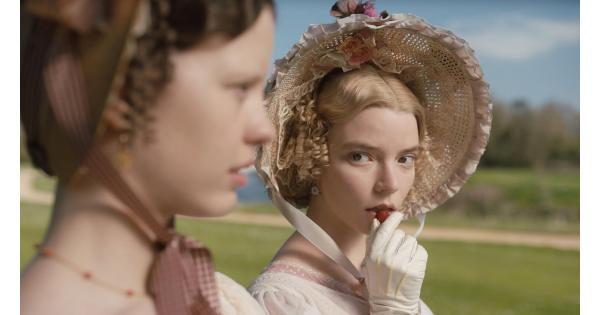
You’re likely not alone if you’ve never heard of Emma, a much-adapted but lesser-known and underpraised Jane Austen novel about someone she described as “a heroine whom no one but myself will much like.” I suspect that only diehard Austen fans or big nerds had much foreknowledge of this particular piece, but as a member of both groups, I was looking forward from the moment this new adaptation was announced. Emma was, for years, my favorite Austen; I’ve grown up to realize just how young and stupid I was for not properly appreciating Pride and Prejudice, but as a younger and stupider reader it was gratifying to read a story about a character who, despite her best intentions, can’t help but ruin the people around her. It also helps that Emma is, as a rom-com, more reliant on the com—think Much Ado over Romeo and Juliet. Its lovers are cute and quarrelsome, and their eventual get-together is the kind of thing that’ll make you fondly smile more than openly weep. You might weep a little because of how fondly you’re smiling (I certainly did) but Emma, both the book, movie, and character, are all shooting for entertainment over capital-L Love. And come to think of it, this movie—“emma.”, as I categorically refuse to style it—has quite a bit in common with its main character. It’s “handsome, clever, and rich,” a vibrant romp of a film that’s unafraid to flex its comedic chops. It’s also, like Emma, a little bit too clever for its own good, and I wish it’d let the people around it handle themselves.
I can’t possibly introduce Emma better than Austen did, so I’ll just copy the opening lines here to get us into this thing: “Emma Woodhouse…seemed to unite some of the best blessings of existence; and had lived nearly twenty-one years in the world with very little to distress or vex her.” Emma is, broadly, about Emma’s selfish and occasionally catastrophic attempts at matchmaking and their ensuing fallout, but it’s also about the way that she and the rich folks around are nearly incapable of understanding a circumstance other than their own. The movie keeps this general frame, but smartly gives more screentime and plot heft to Harriet, (again, Austen does it best, so I’ll let her make the introductions as) “a natural daughter of somebody,” a poor and functionally orphaned young woman that Emma quickly befriends and seeks to better, with dramatically varying results. Emma is as much about her as it is about Emma, and this helps illuminate the contrast between the two and drive home Emma’s thoughtlessness and eventual transformation into sharper relief. The rest of the plot isn’t always as careful—Emma feels like it keeps debonair Frank Churchill or town bore Mrs. Bates in the movie largely out of necessity rather than dramatic purpose—but that’s not a dealbreaker in a movie this fun to watch.
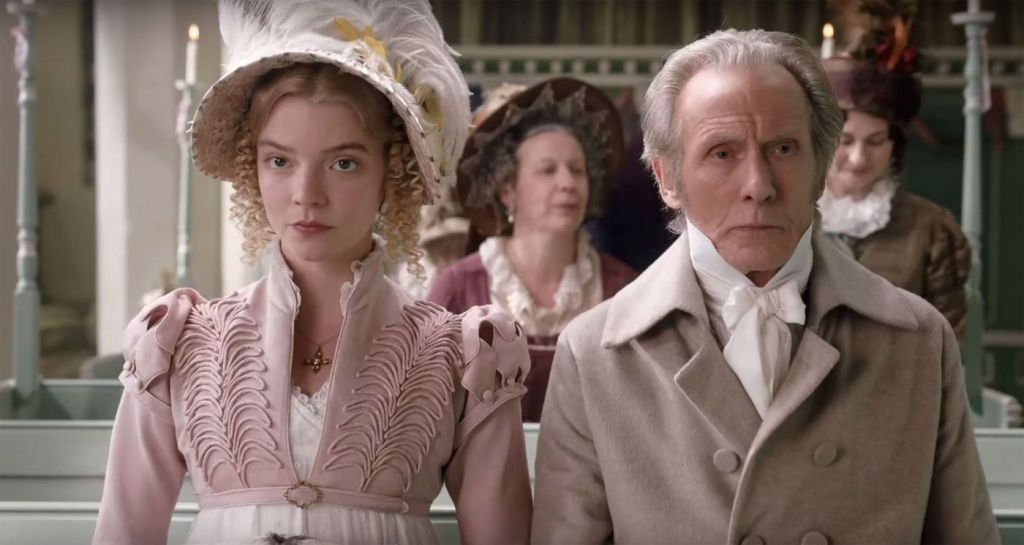
Because Emma really, really is funny. Or rather, it’s droll, but it’s packed with drollity, the kind of humor that won’t send you howling but guarantees an amused chuckle about once every minute. The film makes a smart choice leaning into the comedic leanings of the original novel and goes, well, not for broke, but about as broke as an authentic Austen period drama can reasonably go, pushing right up against the intrinsic borders of its genre. Everything feels a little preternatural, from the acting choices (e.g. Bill Nighy’s tendency to hop into place) to the blocking (commonly and intensely theatrically sitting on a couch). And the costumes! What costumes! I’m hardly well-versed on the subject, but the costume and makeup design all feel deliberately and delectably overboard. Emma’s hair is wound into absurdly tight spirals. Mr. Elton, a sleazy preacher, is drowning in a frock at least one size too big. Nearly every male character is craning their neck to see over the absurdly high starched collars. Again, I’m no expert, and it’s entirely possible these are period-appropriate and accurate looks, but even if they are, they’re chosen with such evident care and precision that almost every screenshot of Emma could elicit a laugh on its own.
This endeavor to pack the movie with a distinctly un-packable wry humor, though, does start to wear thin when taken as a whole. There’s only so many times that Anya Taylor-Joy, as tremendously talented as she is, can stifle a scoff at someone’s behavior before we start expecting her to look at the camera like a 19th-century Jim Halpert. Having satisfactorily established that Emma’s kind of a jerk, Emma keeps trying to play it for laughs, at least an hour after we stopped laughing the first time, and while the joke never really gets bad it can certainly edge into tiresome, especially considering how the actors can expand to fill the silence. When Emma takes a break from winking and lets its actors act, it becomes riveting–there’s a scene between Emma and Elton in a snowbound carriage that lets both Taylor-Joy and Josh O’Connor unleash some impressive talent, and then, with an audible “clunk,” the lever is flipped back to Comedy and Mr. Elton does a funny scream. It’s a shame, because director Autumn de Wilde, making her feature debut here, is obviously quite talented at both comedic and dramatic work, but seems to lack the surehandedness of, say, a Nora Ephron or Armando Ianucci to let them cohabitate.
But that’s no great matter. I’m greatly looking forward to the next films de Wilde makes with more experience under her belt, and in the meantime, Emma’s a more than capable movie. It’s an energetic and thoroughly entertaining period piece, and if you’re willing to overlook its clunkier aspects–which you should, and unless you’re a very sour soul, will–you’ll indeed be energized and thoroughly entertained. Very thankful that this new adaptation gives me yet another reason to do what I’ve been doing for a decade already and heartily recommend Emma.
 Movies That Are Worse Than “Mad Max: Fury Road” (2015)