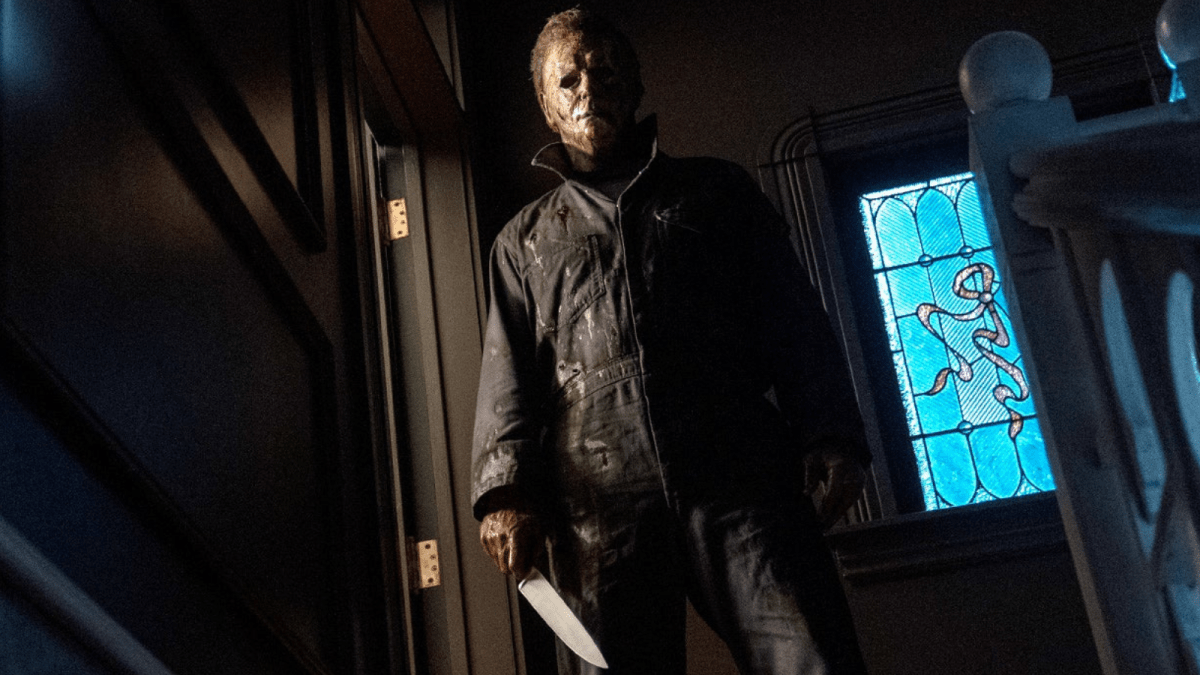
If you’re not up on your lore and are confused by the litany of sequels, spin-offs, and reimaginings, Halloween Ends is the conclusion to the most recent sequel/spinoff/reimagining trilogy, and allegedly, the end of the series as a whole (but come on, guys, we know you’ll exhume that corpse the second you think you could make more money off it). This trilogy has the distinct advantage of being entirely helmed by the same person throughout, David Gordon Green, a talented director with a solid resume. Unfortunately for him, and for us, he’s had to make Halloween movies, something he seems to resent. Here, he wants to tell serious stories and guide meditations on violence, but if that violence takes the form of the actual Michael Myers, it’s hard to follow his train of thought. It’s the thing that, in my opinion, somewhat undermines the entire affair. In the 2018 Halloween, it’s hard to dismiss Laurie Strode as addled and broken because it’s, you know, Michael Myers. In Halloween Kills, you can’t take any cautionary statements about mob justice seriously if the mob is organized against, you know, Michael Myers. And in Ends, when Laurie starts pontificating about the nature of evil, in another movie you’d absolutely agree with the other characters, who uniformly dismiss her as a bit of a nutbag. But here? You want to take everyone else by the shoulders, shake them, and yell, “you’re in a Halloween movie! With, you know, Michael Myers!”
That’s a sour intro, and it’s not to say that the film’s floor-to-ceiling bad. Halloween Ends takes an ambitious swing that I will not spoil but takes up most of its runtime, and it largely works. The cast is game, the crew is on point, it’s a perfectly functional and, at times, halfway interesting Taxi Driver pastiche. But this movie is yoked to an IP that won’t stop getting in the way, and we’re reminded every five minutes or so of a Halloween mythology that Ends cares deeply about but simultaneously doesn’t have much to say on. There’s small-town drama happening and Michael and Laurie won’t stop poking their heads in and reminding us this isn’t actually a small-town drama, it’s a fated clash between titans. It all starts to feel a bit silly and that, I think, is where the movie lost me. Not to say that horror shouldn’t or can’t be silly–I’m one of the entire Evil Dead trilogy’s bravest and most special soldiers–but when Halloween Ends insists that it’s a serious movie, we watch it as a serious movie, and the cornucopia of times it’s overblown, bizarre, or straining the limits of plausibility stop being fun little nitpicks and start being fatal flaws. Take, for example, Laurie’s granddaughter Allyson (Andi Matichak) and her burgeoning romance with the town pariah Corey (Rohan Campbell). Allyson falls near-instantly for Corey, a visibly and violently unwell young man, and within seconds of meeting him, decides that they’re fated to be together and refuses to ever, ever cut ties. There are two paths to make this plotline work: you could paper over it and just let it happen because This Is What Happens In The Movie, or you could spend the time to pace it out, provide the detail, let the characters grow. Ends wants to take this second path, and I believe, given more time and space, it could have. Corey’s established from the jump as a sympathetic character, consistently in the wrong place at the wrong time, and Allyson’s clearly portrayed as a woman absolutely sick of midwestern suburbia who’s already got a history of unlucky relationships with violent jerks (a local police officer played by a pitch-perfect Jesse C. Boyd). But it doesn’t have that time to let this plot sit in the proving drawer–here’s Laurie Strode writing her memoir. We can’t give these characters room to breathe, because oooooooooh Michael’s back!
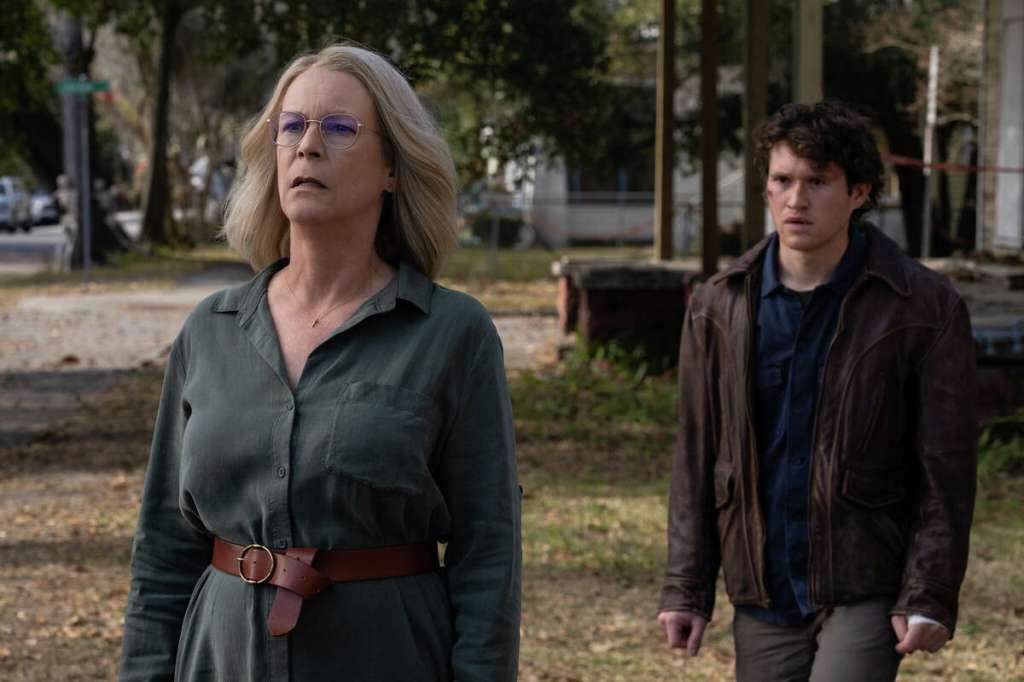
It might sound like I’m grousing that a Halloween movie had Michael Myers in it, largely because I am. To clarify: it feels like Halloween Ends is two movies forced to cohabitate the same screen. One scene of Nightcrawler, switch projectors, one scene of H20, repeat. Both movies look fun, and are made decently well–neither movie pairs well with the other. Or against the original. Full disclosure: a few days before seeing Halloween Ends, I had the immense pleasure of rewatching Carpenter’s 1978 Halloween with a few friends who’d never seen it before, and boy howdy that movie still bangs–patient, careful, composed and shot with an effortless grace. The sequence of Michael attacking Laurie is still absolutely terrifying, and the movie around it is, at least in my opinion, one of the best horror movies ever made. It also, alongside Ends, feels like Goofus and Gallant. Ends wants to chronicle the story of Michael, figure out how the man is made–Halloween posits that the more frightening choice is that he just is, a latent force of nature that breaks a professional psychotherapist to the point of chasing him down with a loaded gun. Ends is lit flat and bright throughout, including a midnight showdown in a kitchen that looks like it’s happening mid-afternoon–Halloween is unafraid of using darkness, letting its shots be flooded with an indiscernible shadow. Ends’ violence is explosive, gruesome, and at several moments almost comedic–Halloween is sparing and visceral, saving it for when it matters most. Ends even uses a direct homage to a slasher movie superlative kill, as Michael, just like in the original, hangs his prey on the wall with one brutal stab. In the original, the shot stays wide, and Michael cocks his head like a puppy. Still gives me chills. In Ends, the camera pans down to watch blood drip down the victim’s foot…? To communicate that…they’re dead? Why? There’s no match cut that the blood droplets set up, there’s no real thematic presence of blood besides the obvious, and like all of Halloween Ends, it’s grim, overwrought, and ultimately competent but pointless.
 Movies That Are Worse Than “Mad Max: Fury Road” (2015)