I’ve never really gotten Star Wars.
I’ve watched every main series movie and some of the various shows, but the property’s never gelled with me the way that it’s seemed to for so many of my contemporaries. This, obviously, isn’t a value judgement, but I do think it’s worth noting, because I’m not approaching this as a fan. I’m not here read up or, frankly, particularly interested in the lore; I don’t care if my favorite character shows up and says a cool line or not; I’m here to watch a movie, the final in a trilogy, and on that particular baseline, I found myself surprisingly and immensely let down by The Rise of Skywalker.
Like I said, Star Wars was never really my thing, I suspect in part thanks to its obsessive backstorying. The stormtrooper that Luke stole the armor from? His name is TK-422, and he’s in multiple comic books. The droid that malfunctions just before the Skywalker family purchases it? That’s R5-D4, obviously, a secret rebel agent who self-destructed on purpose to keep R2-D2 and C3PO together. The extra that appears in one shot, running through Bespin with what’s clearly a hastily painted ice cream maker the prop department handed out? You idiot, that’s Willrow Hood, who just three years ago had to flee a hijiacked Star Destroyer in fear of an overloaded reactor, and his ice cream maker is actually a secure storage device you’ll see in multiple episodes of The Mandalorian.
Again, none of this is bad, per se—but it does assume, in any willing participant in Star Wars media, the desire to seek out this kind of extraneous information, to enhance our understanding of a piece of narrative we assumed was whole and self-contained. I’m not here to badmouth that urge; it’s clearly worked for millions of people, but personally, I find this exhausting. I’ve little interest in appendices and auxiliaries, which is partially why I, not really a fan, was absolutely enchanted with The Last Jedi, a breath of fresh air in a crowded genre universe.
With this obsessive chronicling, the Star Wars universe places an immense importance on the power of inheritance and bloodline, whether figuratively (the now-titular Skywalker dynasty) or literally (the somehow still-canonical midichlorians). But I loved TLJ’s disavowal of nostalgia, its open refusal to define itself by what came before. Its characters were troubled, difficult people who had flaws, and more importantly, whose flaws couldn’t be explained or whose power couldn’t be foreshadowed by their parents. Daisy Ridley’s compelling and vulnerable Rey is not interesting because of her dad; she is interesting because of who she is, and TLJ takes away any easy answers and makes her find her place in the universe on her own. It sees its characters as capable of making mistakes—not miscalculations, not accidents, but genuine mistakes—and this, consequently, allows these characters to grow and the world they inhabit to expand, without relying on any visual dictionaries or spinoff TV shows. Poe’s refusal to follow the orders of a commanding officer that clearly knows more than he does result in blood of his fellow soldiers on his hands, and this lets him—and us—realize the cost of war. Finn wants to be a Resistance hero, but his cowardice and uncertainty mean that he has to learn what that means through the efforts of a character clearly better suited for the job. And most strikingly, the Jedi Master Luke Skywalker himself is not the hero that Rey and the audience want him to be, he’s the last of a dying order who’s cracking under the weight of the world around him. No character is perfect, and this lends their failures weight and their successes approaching something like majesty.
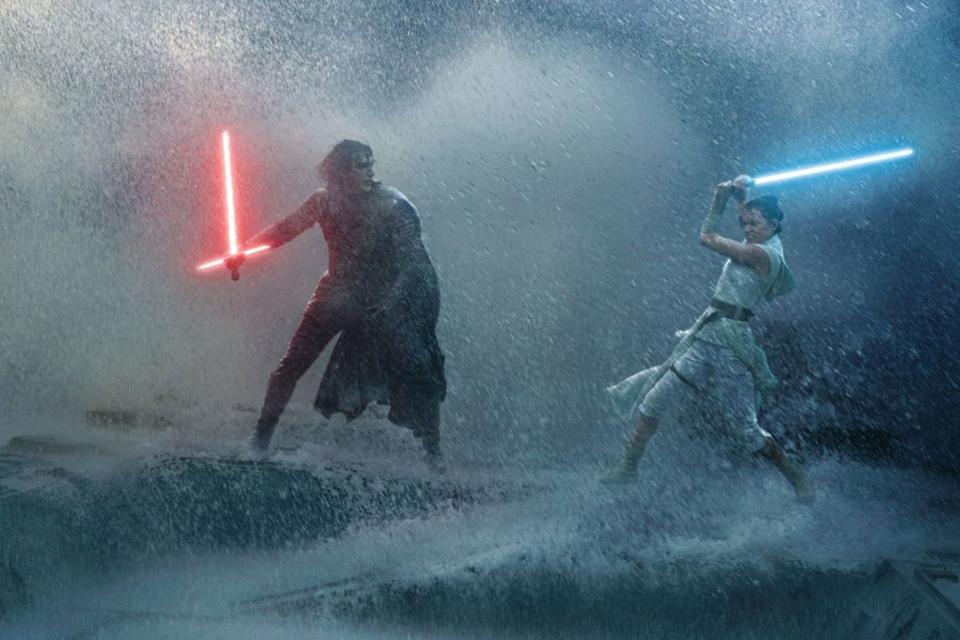
In contrast, these same characters in TRoS are incapable of making any wrong choices, and it drains the narrative of uncertainty or impact. Finn orders a bizarre tactic because he has an “instinct,” and it’s completely correct and wins the battle. Poe escapes the First Order by using a flight path we’re told is dangerous, but absolutely nothing goes wrong and they arrive safely at base. And in one of the movie’s most frustrating moments, as if taunting a better plot, after Rey’s anger and fear lead her to unleash a power that kills Chewbacca, it’s revealed to be a fakeout in under five minutes. Nobody gets hurt, nobody learns anything, and we never doubt that our heroes will do exactly what they say they will. The complete lack of tension would be frustrating in any movie, but it’s especially challenging in one that wants us to accept Rey’s alleged moral uncertainty is a major plot point. Will Rey fall to the dark side? No, obviously, she won’t, because in TRoS she never does anything to indicate that she’s even remotely susceptible. Sure, she has visions of herself taking Palpatine’s place, but she says that she won’t, and we’re (correctly) given no reason to doubt her. If TRoS truly wanted to expand on this plot thread, it would have done well to pick up from where TLJ left off, the memorable throne room fight scene, but this, like every good idea TLJ had, is retconned, apologized for, or straight-up ignored. Luke catches the lightsaber, Kylo’s mask is reforged—what was the point of making a sequel if the first hour of the next movie would be spent saying “just kidding?”
In Abrams’ defense, he can’t have had an easy go plotting this movie—he’s a talented craftsman, but originality has never been his strongest suit. Bafflingly, despite having more money than we’ll ever understand and command of one of the most popular media franchises of all time, Disney didn’t have a post-it wall or something detailing the plot arc of its massive reboot, and Abrams was forced to follow a controversial film from a director known for trope-breaking with one of his principal players, the late great Carrie Fisher, gone from the picture.
In Abrams’ attack, however, he and screenwriter Chris Terrio have created a final film in a trilogy that point-blank refuses to “yes, and” any of the movies before it, creating a bizarre sense of both over-familiarity and discontinuity. In a move that not only has no precedent in the earlier movies but completely devalues Vader’s sacrifice at Return of the Jedi, Palpatine has somehow returned from the dead (a plot element hand-waved away with “the dark side of the Force” and an impressive piece of set-dressing), but we don’t even get to see this critical inciting event because it happened, of all places, in Fortnite. This sets the tone for a movie that feels like it was written round-robin: Rey shouts “never doubt a droid” literal seconds after we watched her doubt a droid. First Order ships explode over Endor and Jakku, somehow, and we’re never shown why. Kylo kills some people at the beginning, I guess, presumably because they needed a combat shot for the trailer. Consequently, the end to this series forty years in the making feels weightless, because it turns down the force of any prior films and relies on its own dribbling impact.
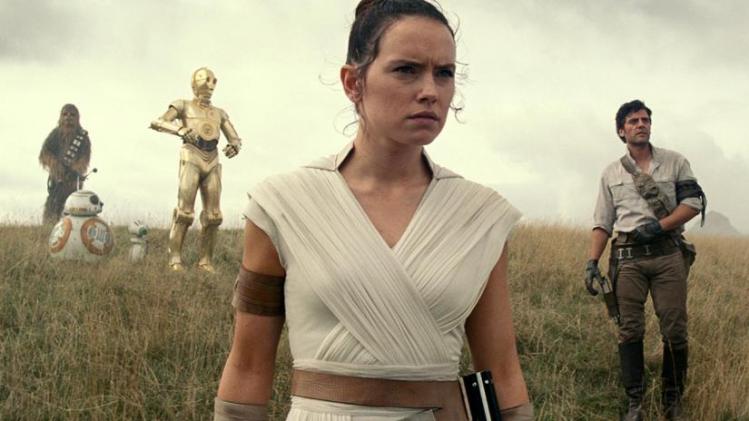
This is doubly frustrating because across this new trilogy, the central cast has uniformly held their own. Ridley, Boyega, Isaac, and Driver are gifted actors that, despite being ping-ponged from director to director, have still given their choices power and meaning, a challenge that they meet with aplomb, but still means nothing alongside the script’s total lack of drive.
Some questions, in no particular order:
-What purpose does Zorii serve, if not Disney feebly hanging a massive “no homo” sign over Poe? I’m aware she gives him some macguffin or other, but he could have tripped over it with exactly the same plot consequence, so why waste my time, and more importantly, Keri Russell’s time?
-What in the world is a force dyad? Did I hear that correctly, and is it as inane as it sounds, and did we really need a whole new concept to explain why Palpatine is draining them both? Couldn’t we have just assumed it was because they’re both powerful Force users?
-Why does Finn not tell Rey whatever he was going to, and why did Abrams wait until after the movie to say it was “I’m force-sensitive?” Was he just leaving an open slot in the script to cover himself in case of poor reception emergency?
-Why in God’s name do Rey and Kylo kiss? What possible point does that serve? Who thought any of their interactions in any movie, including this one, indicated romantic or sexual feelings for each other, and has that person ever had romance and/or sex?
-Why does Dominic Monaghan have a role that transparently was once Kelly Marie Tran’s? What cruelty prompted the team to make her stand directly next to him in every shot and watch as he says her lines?
I don’t mean to harp, much as I love harping. I can understand a part of the negative response to TLJ, and I understand why this movie was intended as a course correction. I walked in knowing I wouldn’t love it. But I expected a certain degree of technical competence, of plot logic, of whizz-bang-pow, and every part of this is all but absent. The Rise of Skywalker has been smoothed to avoid criticism, but in this smoothing, every possible edge has been filed off, and it leaves us with almost three hours sanded down to nothing.
 Movies That Are Worse Than “Mad Max: Fury Road” (2015)