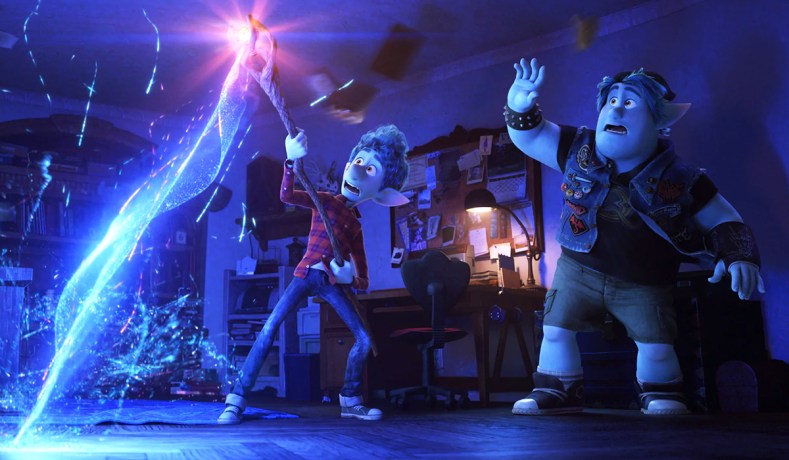
I had a creeping suspicion midway through Onward: there’s no reason this movie had to be set in a fantasy world, and the plot would have worked exactly as well in, say, the middle of Illinois. This is disappointing both as a regular Pixar attendee and an utter sucker for the fantastic, but it’s true; swap in a delay on the acceptance of magic and forget a handful of sight gags, and there’s nothing you’d really lose. I’m not saying this as a doctrinaire–obviously, the existence of centaurs and sprites and forgotten cantrips lets you get away with quite a bit, and I understand why they’re there. But aside from our central characters, their wizard staff, and their ½-resurrected dad, there’s almost nothing to marvel at. It doesn’t break the movie, a competent family road trip, but it’s emblematic of its larger problem: for all its talk of magic, Onward is thoroughly mundane.
Tom Holland and Chris Pratt play Ian and Barley Lightfoot, a pair of elfin brothers in a fantasy world now wholly moved on from enchantments to electricity. Both brothers never really knew their father, who died when they were young, and on Ian’s 16th birthday their mother reveals his last gift: their father’s magic staff, along with a spell that will bring him back for 24 hours. But when Ian botches the spell and only brings back his father’s legs, the brothers set off to find another magic focus and cast it right before the clock runs out and their dad is gone for good. It should be apparent by this point that Pixar’s doing their usual thing and fishing for heartstrings, but if it sounds a little more crass than usual, that’s because it is. Much of the plots precedes like you’d expect it to–journeys of self-knowledge, empowerment, a comedy chase scene or two–but this time around, the artifice feels more transparent than usual. There’s little connective tissue between scenes, and character and plot arcs begin and conclude with alarming frequency; a dance number closes a game-changing rift, and one character moment is handled with an actual checklist of growth. The film’s main conceit, Ian learning how to cast spells, is not an uninteresting idea, but it’s done so ham-handedly it’s hard to get engaged (Barley quite literally yells that spells have to be cast from your “heart-fire” over and over again until we get what he’s saying by proxy). This feels, at least in part, because Onward doesn’t seem to know what it’s about. It shuffles its feet around “staying connected to your past,” “trust those you love,” and “believe in yourself,” and by the time it finally arrives at “the meaning of family” the movie’s almost done.
I’m about to criticize this movie some more, so before that happens allow me to interrupt myself and say that Onward isn’t bad. It’s perfectly functional, and functional for Pixar, some of the best living animators, is no small deal. That vaunted animation is, as always, impeccable; the voice actors, from Disney stalwarts Holland and Pratt to newcomers Julia Louis-Dreyfuss and Octavia Spencer, are game and capable; and the plot, as banal as it can be, hits its marks well enough. Nothing here is bad, but everything lacks a certain je ne sais quoi. Maybe it’s because Pixar’s making more movies more frequently than it used to, maybe it’s because Disney is exerting greater creative control, maybe it’s because every animated movie I’ve seen after Into the Spider-Verse has felt just a little less fun in comparison. But whatever the reason, ultimately, I was most disheartened not by what Onward was, but what it wasn’t.
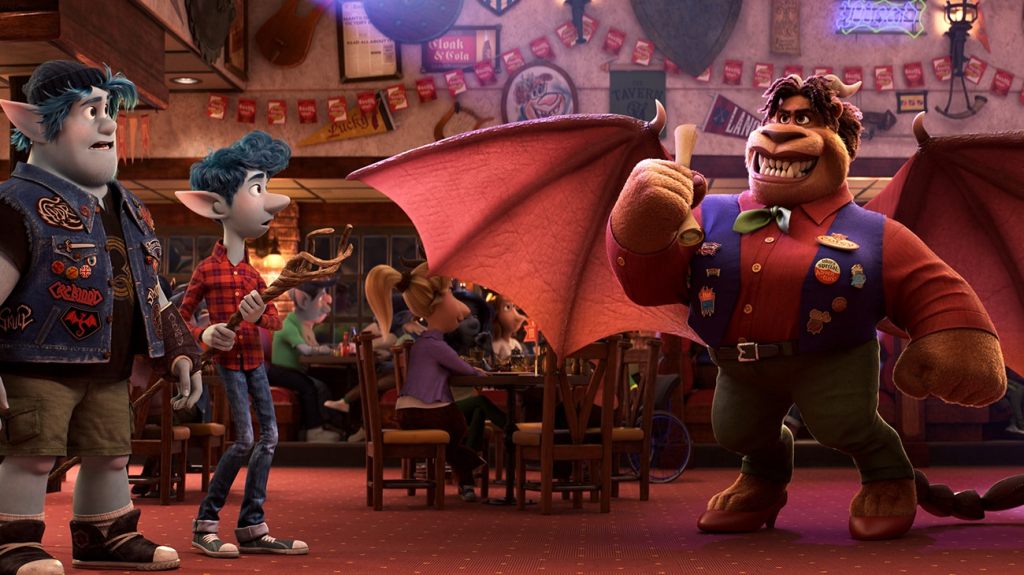
Because when Onward finally lets loose and leans into the delightful incongruity of its setting, the results can be, well, magical. Most of the movie exists as no more than a palette-swap–dragons for dogs, mushroom tops for gabled roofs, ogres and cyclops for schoolchildren–but whenever it lets itself grapple with its stated identity, a land built by a magic now forgotten, it becomes a blast. I got my first hint of this with the Manticore’s Tavern, once a hub of adventure run by the fearsome Manticore, now a family restaurant because that brings far fewer lawsuits. It’s not the freshest of bits, but it’s the first time since the inciting incident that the film really feels like it’s doing something worth noting. We get intermittent spurts of activity all the way up until the final scene, an exhilarating setpiece with Onward’s most clever both-worlds design by far. It’s all the more a shame, then, that the rest seems almost defiant in its refusal to let itself have fun with its own premise. I’m reminded of Zootopia, a movie with another far-out premise that absolutely overflowed with creativity and sheer visual glee. Onward sets itself up for the same kind of ingenuity, but is almost afraid to engage with it. We never get to see what a car designed for centaurs looks like, we’re not allowed different classroom desks for a populace demonstrably variable in size and species, and the motorcycle-riding pixies, an idea the film is clearly proud of, don’t get any kind of screentime to explain how they’re doing what they’re doing. We just see motorcycles driving, and are asked to fill in the blanks ourselves.
Again, truly, it isn’t a bad movie. It is, however, a markedly disappointing one. Almost all Pixar movies, even the ones I don’t really care for (Up and Inside Out are the big two) reliably swing for the fences, which is why it’s such a letdown that Onward never really strives for anything beyond competence. And maybe, for some folks, that’s enough; Pixar is playing to its core proficiencies here, and it’s doing so with a significant amount of talent and experience. But I’ve come to expect more, and frankly, much like the world it inhabits, Onward is in desperate need of a little more magic.
 Movies That Are Worse Than “Mad Max: Fury Road” (2015)