Marcus Aurelius once wrote “things in themselves have no power to extort a verdict from you”–or, in essence, it’s fine to not have a hot take on something. It’s probably already indicative of the quality of Smile that I spent its runtime thinking about Marcus Aurelius rather than a scary smile or whatever, and if you’d like, you can now do what I should have done at the movie; namely, take this early pithy little point, get out of here, and spend the next bit of your life doing something better. Read something non-fiction! Go for a walk! It’s lovely outside.
Still here? Fine. I’ll only take a few minutes of your time, and in that time I hope I can convince you to not make my mistake.
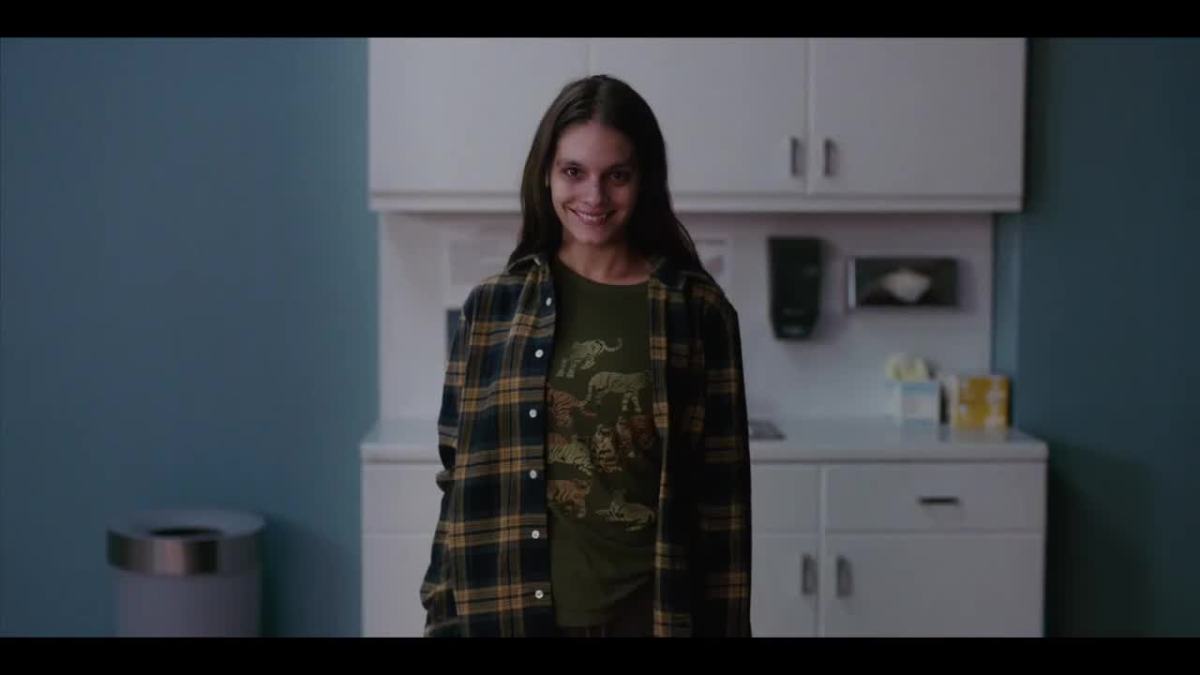
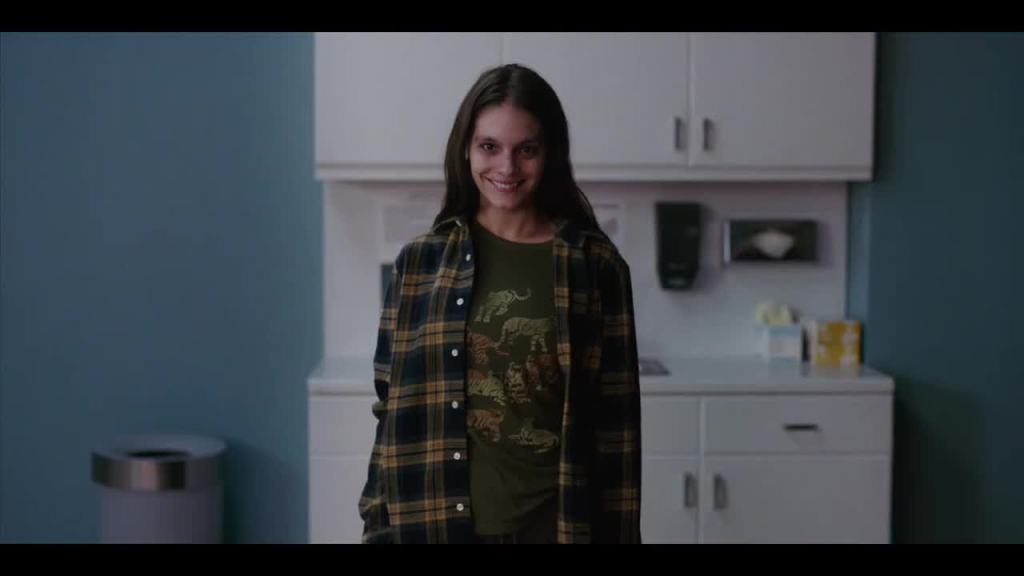
Smile is adapted from writer/director Parker Finn’s 2020 short Laura Hasn’t Slept, and wow, does it feel like it. Or to be more accurate, the opening sequence is a clinically tense and unnerving short with some genuine visual flair, with a listless, boilerplate movie stapled onto it, dragging its feet through the rest of its runtime. But for those first ten minutes! Dr. Rose Cotter (Sosie Bacon), a hospital psychiatrist, walks into a holding room at the end of her shift to help Laura (Caitlin Stasey), a grad student who’s clearly unwell. She’s whimpering in the corner, she looks like she hasn’t slept in days, she’s variously whispering and shrieking about an entity only she can see. It’s smiling at her, she says, wearing the faces of people she knows. Then she screams, knocks over the furniture, and–as Dr. Cotter calls for help–locks eyes with her, freezes into a rictus grin, and slowly and deliberately cuts her own throat. It’s fun! Or, you know, it was fun for me. Your mileage may vary. It’s undeniably well-made, at least. The set is sparse, the music is basically absent, Finn and cinematographer Charlie Sarroff keep the shot dead-on, as the actors take turns delivering lines directly into the camera. They can’t hide, and neither can we. It’s clever, and it works, and then this sequence ends and almost every ounce of creativity, of panache, even of the titular smile goes out the window.
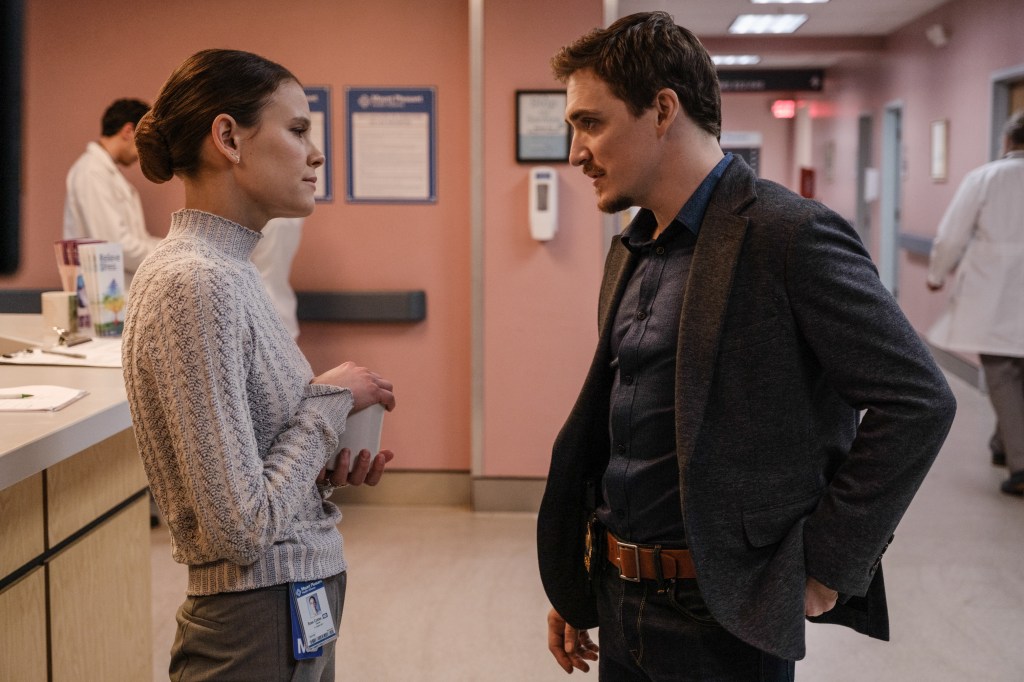
I should clarify something here, I think. Smile is, in a lot of ways, a cheap movie. I don’t begrudge it this–point in fact, I love cheap horror movies. I walked in expecting a cheap horror movie, because Smile is squarely marketed as a cheap horror movie, the kind of thing you put on when it’s 11PM at your junior high sleepover and you don’t want to go to bed just yet (e.g., in the weeks before its release, Paramount paid actors to stand in the crowd at MLB games and grin wickedly into the broadcast cameras). But cheap horror movies used to have a certain self-knowledge, which Smile lacks pretty desperately, I realized as the movie reveals its grand design–I’m about trauma, it says. I’m a serious horror movie, and I’m about trauma. This isn’t a bad thing. Several horror movies, including Smile’s clear inspirations The Babadook and It Follows, deal explicitly and textually with trauma as a malignant force using the parlance of the genre. Both of these movies, though, along with the other exemplars of the genre, have a clear and informed point, something worth saying, a nuanced position in both narrative and metatextual terms. Smile has a scary smile, and barely even that. I didn’t mention Marcus Aurelius earlier idly–I would have given anything for Smile to lean into itself, to be the fun, nerve-rattling spook-em-up that it absolutely excels at in the opening sequence. There’s flashes of it throughout, in dream sequences that continually taunt us as visions from a better, more honest, more entertaining version of the movie. But no, Smile insists–I’m about trauma. I’m a serious horror movie, and I’m about trauma. We can’t have fun here, I’m about trauma. We can’t bring back our scary smile at basically any point besides the first and last acts, I’m about trauma. We can afford to paper over absolutely insane leaps of logic, and the lack thereof, because I’m about trauma. We’re going to show you a brightly-lit close-up of the main antagonist, and it’s going to look like the silliest thing you’ve ever seen, a Bratz doll that you threw in the dryer, but we need you to understand it as frightening because it’s related to the main character’s backstory, and by God I am a Serious Horror Movie, and I’m About Trauma. And when we finally calm Smile down, quiet its yelling, tire out its running around New Jersey, promise to listen very carefully, what does this Serious Horror Movie have to say about Trauma? It proudly opens its mouth and declares “it would be better for everyone if you left and killed yourself.”
I suspect, and this is incredibly the idle wonderings of an amateur with barely any industry insight, that the critical and commercial success of the A24 brand of creepshow–Hereditary, The VVitch, and its stylistic siblings like the aforementioned Babadook and It Follows–has led to a belief that so-called “elevated” horror is easy. Find yourself a white family with issues, roll the camera a little bit, hurt a violin in the background, and you’re set, rake in the dough and the 88% on Rotten Tomatoes! But what this supposition ignores, lethally so, is that doing this approach well is incredibly difficult, requiring a huge amount of care and precision. There’s no shame in having a monster jump out at the camera, but if you want to wring fear out of, say, a family with PTSD, you have to fine-tune the dynamics of your characters and the world the same way that John Carpenter would calibrate prosthetics for The Thing. You can’t just extend a solid proof of concept by nearly two hours, say it’s about trauma because the main character’s had a tough home life, and call it a day.
I’m pontificating here because I’m bummed about what I have to say in conclusion: ultimately, I found myself alternatively bored and frustrated with Smile, a movie that really, really could have been enjoyable. There’s a good movie somewhere in here, but it didn’t survive the transplant to feature length. I couldn’t say who’s to blame, nor would I want to–there’s some talented folks on this thing, and I’ll check out whatever they do next. I just hope it’s either more or less about trauma than this.

 Movies That Are Worse Than “Mad Max: Fury Road” (2015)