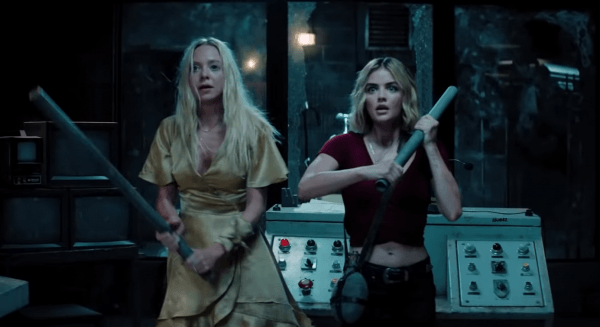
As I’ve reviewed thus far, I’ve eschewed giving any hard grades—stars, numbers, letters, or otherwise—for a handful of reasons. All art, and all criticism of it, is wholly dependent on the individual viewing it, and besides, to assign a film some kind of quantifiable value seems to miss the point of reviews. The first film I wrote about here, CATS, is a trainwreck by nearly any measure, but I’m still excited to see it again; The Revenant is a technically competent and well-made movie that I loathe with every fiber of my being. Data can’t find the full measure of a film, and reviews shouldn’t presume objectivity.
Except this one, because with those caveats out of the way, let me now say that Fantasy Island is, objectively, the worst movie I’ve ever seen in theatres. 0/10, two thumbs down, F-minus. Again, objectively.
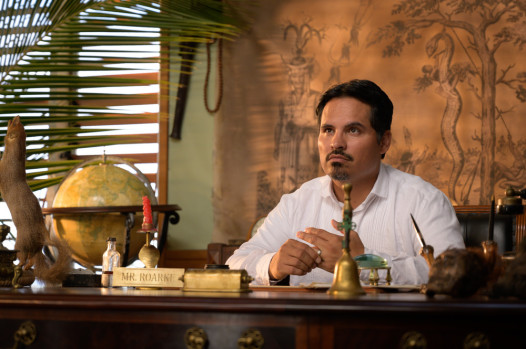
From the moment the concept was teased, I was baffled—for those of you who don’t know, Fantasy Island was originally a late 70s-early 80s TV show, starring Ricardo Montalbán as Mr. Roarke, the proprietor of an island getaway that brought its guests’ wildest dreams to life (and here imagine a dramatic pause before you read) though those dreams are not always what they expect. I’ve seen little of the original series, but what I saw was chintzy and amusing fare; think a more lighthearted Twilight Zone and you won’t be far off the mark. In at least one episode, Mr. Roarke encounters the Devil, and they talk like they’re both certain the other is cheating at penny blackjack. So who is this new movie for? The people familiar with Fantasy Island 1.0 will be shocked at its reduction to a cheap, crass “careful what you wish for” vehicle, and the people who aren’t will snicker every time a character says “fantasy” with a straight face.
Hollywood’s lack of original ideas is a drum well beaten, though, so let’s give them that. If we must be this psychotically exhaustive in our graverobbing, I’ll even grant that “Fantasy Island, but more,” isn’t an awful pitch for a modern horror film. The idea of a Needful Things vacation service, self-indulgent wish fulfillment on an island resort taken to its logical conclusion, is evocative on its own. You’ll note, though, the keyword “logic,” something the screenwriters had apparently only heard tales of from distant shores. The movie spends a significant chunk of its runtime trying to quantify, through various mouthpieces, how its mythology works, which would be impressive dedication if any of it made a lick of a sense.
So let’s set aside the utterly wild explanation of why Mr. Roarke is here in the first place, the island’s simultaneously cavalier attitude towards and tenuous capabilities of resurrection, and the untold multitude of skips and errors, and just play along with me for a second–let’s pretend you’re a screenwriter for Blumhouse. Your task is simple today: you’re to find a suitable fate for two of your characters, a pair of gently dim party bros, played by Ryan Hansen and Silicon Valley’s Jimmy O. Yang. They (presumably) love to party, but are (presumably) beset by some kind of troubles that prevent this (you’ve already given up on writing any of this exposition). Their fantasy, their ultimate wish, is to “have it all.” How do you, the malicious and technicality-minded genie in this bottle, doom them to their grisly but PG-13 destiny? Their ambiguous wording means you could drive a truck through this loophole, so let’s get to work. If you’re me, shooting from the hip, you might do some entry-level body horror–maybe “having it all” includes “all knowledge,” which grotesquely swells their heads and/or drives them mad. Maybe “having it all” meant “consuming it all,” and they’d be forced, Se7en-style, to gorge themselves to death on their new possessions, and if we’re feeling particularly naughty, some unwilling participants. If, however, you’re one of the poor people that actually wrote Fantasy Island, “having it all” means “you have a great big party in a cool house with models, but the house actually used to belong to a cartel or whatever, and it gets raided by a black ops team trying to recover their cocaine, so you have to do an action scene to rescue each other. Now, I guess, you’ve learned the true consequence of having it all, as long as ‘all’ is someone else’s drugs, specifically.”
Every inch of this plot is just as devoid of sense. Towards the end, if you ignore several critical elements, Fantasy Island appears to be putting its pieces together in a halfway interesting manner, until it sweeps those pieces off the table and petulantly announces it’s doing a different, more inane ending now, and then does the exact same thing once more for emphasis. The final picture it appears to be gunning for is vengeance for past misdeeds, a kind of Diet Silent Hill, but it doesn’t have anywhere near the wit, patience, or talent to achieve it. And the swirling void of the plot’s incoherence drags in everything around it. The action sequences, of which there are many, are filmed with shots so shaky it feels like the camera operator was actively falling down in every take. The collective charm of Michaels Peña and Rooker, both capable actors, is completely drained by dialogue that never moves faster than a plod, and the leads, some of whom I’ve both seen and enjoyed before, I’m no longer sure were ever good at acting in the first place.
Look, there’s a lot I can forgive. I’m a grouch, but I like to think I can be lenient, and I get that this particular movie is yoked to a series of tricky obligations–it didn’t have much in the way of budget or shooting time, it’s a torture movie rated for teens, it’s bound to an IP several decades old that people either don’t care about or will extremely care about. But here’s the thing that wholly sinks Fantasy Island: it’s not scary. Not even once. It struggles even being intentionally uncomfortable. It’s a horror movie, or it’s supposed to be, but at no point can it scare you, and that’s the final nail in a coffin that already has so many nails it’s more metal than wood.

 Movies That Are Worse Than “Mad Max: Fury Road” (2015)